
The academic study of religion has reached a strange moment in which scientific success coincides with institutional fragility
The academic study of religion is thriving—and endangered—at the same time. Over the past three decades, empirical and scientific approaches to religion have expanded dramatically, spanning psychometrics, demographics, neuroimaging, evolutionary modeling, and computational simulation. Bibliometric reconstruction shows that these approaches now account for roughly half of all annual publications in the field.
Yet this success rests on an uneasy institutional foundation.
Scientific approaches to religion developed historically in close proximity to the humanities and interpretative social sciences. That relationship has always been uneasy, shaped by concerns about reductionism, scientism, and disciplinary identity. In many contexts, religious-studies departments have responded defensively, wary of broader trends toward scientific hegemony in the modern research university. Meanwhile, scholars pursuing scientific work on religion increasingly find homes elsewhere—psychology, sociology, anthropology, medicine, public health, data science—often without sustained engagement with humanities-based expertise in religion.
For years, this uneasy equilibrium held.
It is now breaking down. Across multiple countries—including the United States, the United Kingdom, Australia, New Zealand, and beyond—humanities departments are contracting or closing. Religion departments have proven especially vulnerable, not least because the academic study of religion sits at the intersection of unresolved conceptual, political, and methodological disputes.
One might assume that the scientific study of religion is insulated from these developments. The opposite is true. As humanities-based religious studies erode, scientific approaches lose a vital partner discipline—one that contributes historical depth, conceptual clarity, linguistic competence, and interpretative sophistication. The result is not simple displacement, but collateral damage.
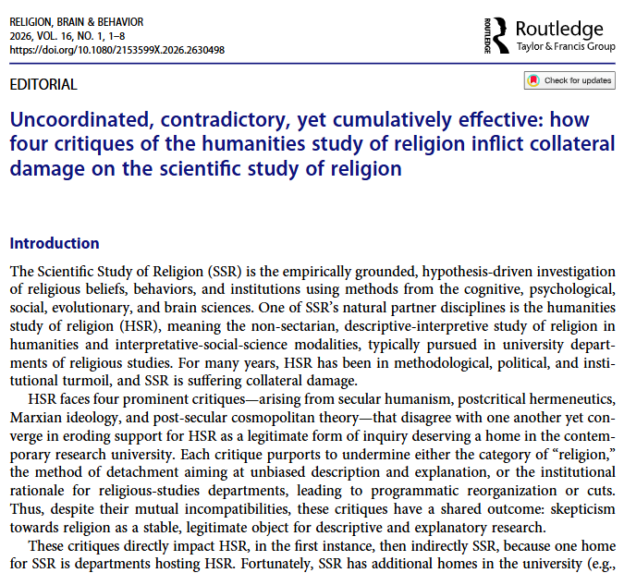
This institutional reality forms the backdrop for a new editorial in Religion, Brain & Behavior (16.1): “Uncoordinated, contradictory, yet cumulatively effective: how four critiques of the humanities study of religion inflict collateral damage on the scientific study of religion.”
The editorial identifies four prominent critiques of the humanities study of religion—arising from secular-dismissive arguments, postcritical hermeneutics, Marxian ideology critique, and post-secular cosmopolitan theory. These critiques often contradict one another. Yet, taken together, they converge in undermining the academic legitimacy and institutional stability of religious studies departments. The effect is cumulative, corrosive, and largely unintended—reshaping the ecosystem in which both humanities and scientific approaches to religion operate.
For scholars across the sciences, social sciences, and humanities, the editorial offers a clear-eyed diagnosis of a complex disciplinary moment—and a case for why the fate of the scientific study of religion is more tightly bound to the humanities than current institutional trends might suggest.